

Sam Houston And Mirabeau Lamar
| Mirabeau B. Lamar | |
|---|---|
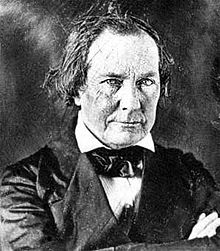 | |
| 2nd President of the Republic of Texas | |
| In office December x, 1838 – December 13, 1841 | |
| Vice President | David G. Burnet |
| Preceded by | Sam Houston |
| Succeeded by | Sam Houston |
| 1st Vice President of the Republic of Texas | |
| In office October 22, 1836 – December 10, 1838 | |
| President | Sam Houston |
| Preceded by | Lorenzo de Zavala (interim) |
| Succeeded past | David Grand. Burnet |
| quaternary Usa Ambassador to Nicaragua | |
| In office February viii, 1858 – May twenty, 1859 | |
| President | James Buchanan |
| Preceded by | John H. Wheeler |
| Succeeded by | Alexander Dimitry |
| third United States Ambassador to Costa Rica | |
| In office September 14, 1858 – May 20, 1859 | |
| President | James Buchanan |
| Preceded by | Solon Borland |
| Succeeded by | Alexander Dimitry |
| Personal details | |
| Built-in | (1798-08-sixteen)August 16, 1798 nearly Louisville, Georgia |
| Died | December 25, 1859(1859-12-25) (aged 61) well-nigh Richmond, Texas |
| Resting place | Morton Cemetery, Richmond, Texas 29°35′09″Northward 95°45′48″W / 29.5858°N 95.7633°W / 29.5858; -95.7633 |
| Nationality | American, Texian |
| Political party | Democratic-Republican Party Democratic Party |
| Spouse(southward) | Tabitha Jordan Lamar (died 1830) Henrietta Maffitt |
| Relations | Lucius Q. C. Lamar (brother) Lucius Q. C. Lamar II (nephew) |
| Children | Rebecca Ann Lamar (born c. 1827) Loretto Evalina Lamar |
| Signature |  |

Mirabeau Buonaparte Lamar (August 16, 1798 – December 25, 1859) was an chaser built-in in Georgia, who became a Texas politician, poet, diplomat, and soldier. He was a leading Texas political figure during the Texas Democracy era. He was elected as the 2nd President of the Republic of Texas after Sam Houston. He was known for waging war against bands of Cherokee and Comanche peoples to push them out of Texas, and for establishing a fund to support public instruction.
Early on life [edit]
Lamar was built-in in 1798 in Louisville, Georgia, and grew upwards at Fairfield, his father's cotton wool plantation nearly Milledgeville, and then the state majuscule. His father'southward family unit was descended from French Huguenot Thomas Lamar, who had settled in Maryland in 1660. His parents, John and Rebecca (Lamar) Lamar had immune his mother's blood brother to name their sons; he named them afterwards his favorite historical heroes. The elder brother was named for the Roman statesman Lucius Quinctius Cincinnatus; the younger, Mirabeau Buonaparte Lamar for French heroes. The family had connections with other families throughout Georgia and the South.[1] [ii] Every bit a child, Lamar loved to read and educated himself through books. Although he was accustomed to Princeton Academy (then called the College of New Bailiwick of jersey), he chose not to attend. He started piece of work as a merchant and then ran a paper, merely both of those enterprises failed. In 1823, Lamar's family connections helped him to proceeds a position every bit the private secretary to the newly elected Georgia Governor George Thousand. Troup. In this position, Lamar issued press releases and toured the land, giving speeches on behalf of the governor. On 1 of his trips, he met Tabitha Burwell Jordan, whom he married in 1826.[3] They had a girl together.[4]
When Troup lost his re-ballot bid in 1828, Lamar moved with his family to Columbus, Georgia, where he established the Columbus Enquirer. [5] This venture was much more successful than his previous business attempts. In 1830, his wife Tabitha died of tuberculosis.[half-dozen] Lamar was deeply affected and took time to recover his drive. He withdrew his name from consideration for re-ballot to the Georgia Senate, in which he had served one term.
After traveling, Lamar began to report law. He was admitted to the bar in 1833 and ran an unsuccessful campaign for a seat in the U.South. Congress.[three]
Texas Revolution [edit]
Lamar's blood brother Lucius committed suicide in 1834. A grief-stricken Lamar began traveling once again to ease his sorrow. In the summer of 1835, he reached Texas, then function of Mexico. He decided to stay, where he was visiting his friend James Fannin. Fannin had recently settled there and was working every bit a slave trader in Velasco.[3] [6]
Later on a trip back to Georgia, Lamar returned to Texas. Learning of a battle for independence, he traveled with his horse and sword to join Sam Houston's army in spring 1836, and distinguished himself with bravery at the Battle of San Jacinto.[iii] On the eve of the battle, Lamar courageously rescued 2 surrounded Texans, an human action that drew a salute from the Mexican lines. I of those rescued was Thomas Jefferson Rusk, later on appointed equally Texas Secretarial assistant of State of war.[7] [ page needed ] Lamar was promoted that dark from private to colonel and given control of the cavalry during the battle the following mean solar day.
Houston noted in his battle study: "Our cavalry, 61 in number, commanded by Mirabeau B. Lamar, (whose gallant and daring conduct on the previous mean solar day, had attracted the admiration of his comrades and called him to that station), placed on our right, completed our line."[eight]
After Texas achieved independence from United mexican states, Lamar was appointed every bit the Secretary of State of war in the interim Texian government. In 1836, he was elected to the position of Vice President of Texas.
President of Texas [edit]
Lamar, the unanimous selection as the nominee of the Democratic Political party for the president to succeed Houston, was elected. He was inaugurated on Dec 1, 1838.[nine] Houston talked for three hours in his farewell address, "which so unnerved Lamar that he was unable to read his inaugural speech."[9] It was given past his adjutant, Algernon P. Thompson.[9] Lamar's vice president was David G. Burnet.
Several weeks later, in his kickoff formal accost to the Texas Congress, Lamar urged that the Cherokee and Comanche tribes be driven from their lands in Texas, even if the tribes had to be destroyed. He proposed to create a national banking company and to secure a loan from either the United States or Europe. Finally, he stated his opposition to potential annexation to the Us and desire to gain recognition of the Republic of Texas by European nations.[9]
He ordered attacks confronting the Indian tribes. In 1839, Texian troops drove the Cherokee bands from the land. Houston'southward friend, Chief Bowles, was killed in battle, and Houston was furious with Lamar. The government conducted a similar campaign against the Comanche. Although losing many lives, the Comanche resisted leaving the expanse.[9] Lamar believed the "total extinction" of the Indian tribes was necessary to make the lands bachelor to whites.[10] He collection the Indians out at the Battle of the Neches, where 500 Texans attacked 800 American Indians of several different tribes. Of these 800, betwixt 400 and 500 were women, children, and elders. The Texians and Rangers who attacked the tribes were fully armed, while the Indians had an estimated sixteen–24 rifles and pistols. Earlier the attack, Duwali, Gatunwali, Big Mush, and other chiefs and leaders asked for fourth dimension to gather their crops, then they would get in peace, but Lamar would not wait.[ citation needed ]. Lamar ordered Secretary of War Albert Sidney Johnston and Full general Thomas J. Rusk to run them out of Texas.
Lamar appointed a commission to select a permanent site for the capital of the Republic. After two months of debate, they recommended the small-scale town of Waterloo, forth the Colorado River toward the center of the country. The town was renamed Austin later the pioneer. By October 1839, all of the records and employees were relocated there from Houston.[ix] That same year, Lamar founded the Texas Country Library (soon known as the Texas Country Library and Archives Commission).[ix]
During his administration, Lamar sent three dissever agents to United mexican states to negotiate a peace settlement, all of which failed. Lamar failed to gain official recognition for Texas from Great Uk, French republic, and Kingdom of belgium; it e'er eluded the would-be nation. He did succeed in getting the three nations to send observers, who would provisionally investigate the issue.[xi] He did not succeed in getting loans approved from them. To fill the treasury, he authorized issuance of a large amount of Republic of Texas newspaper money, known as Redbacks. The newspaper money was virtually worthless. Spending doubled during Lamar's term, and combined with the worthless currency, caused financial difficulties for the government.[ix] [11]
Lamar wanted the Rio Grande to be the western purlieus of Texas. He wanted to send an expedition to New United mexican states to conquer it, and convince the residents, still loyal to United mexican states, to join the Republic. The Texas Congress refused to fund the expedition in 1839 and 1840. In June 1841, Lamar took $89,000 from the treasury and sent an expedition on his own initiative. It was questioned on constitutional grounds. Its members were arrested when they reached Santa Fe, and were told they would soon be released. Instead, under baby-sit, they were marched to prison in Mexico City, and many died during the journey.[eleven]
Lamar has been called "the Father of Texas Education" considering of his provisions of land to back up it. During his administration, he convinced the legislature to gear up aside three leagues of land in each county to be devoted to school development. He also allotted 50 leagues of land for the support of ii universities, later adult every bit Texas A&G University (1876), nether the Morrill Act, and The Academy of Texas (1883). Although no facilities were constructed during his term, he provided the base for a statewide public school arrangement.[9] Government gave 18,000 acres of public land for public schools. He wanted pedagogy to be a priority to cultivate a knowledgeable citizenry.
In keeping with other slave societies in the Due south, Texas prohibited free blacks from schools. A public schoolhouse organisation was non firmly established until after the American Civil War, when the Reconstruction era legislature created an endowment to finance a school system. In 1869, it passed a law to give the public school fund the gain from auction of public lands. The constitution of that year authorized the legislature to institute school districts and engage directors. Freedmen's children were included in the system, despite much opposition.[12]
When Lamar left office in 1841, Texas was about $7 million in debt compared to $1.4 1000000 when he was inaugurated in 1838. The majority of the debt was accrued from carrying out his policies.[13] [14]
Afterward years [edit]

Glaze of arms of Mirabeau B. Lamar
Houston was elected again as president after Lamar. The latter returned to service in the army, and distinguished himself in the U.S. Army at the Battle of Monterrey during the Mexican–American State of war. During this time, coin was tight in Texas; Lamar borrowed money from his banker cousin Gazaway Bugg Lamar. Some of the letters on this subject betwixt the two still exist.[15] In late 1847, he was assigned as a post commander at Laredo, merely disliked the job, every bit he wanted more activeness.[16]
Lamar was elected from Eagle Pass in the Texas Legislature for several years subsequently Texas was annexed to the United States in 1845. In 1857, President James Buchanan appointed Lamar every bit the Government minister to Nicaragua, and a few months later to Republic of costa rica. He served in Managua for 20 months before returning to Texas in October 1859 because of poor health. He died of a heart assail at his Richmond plantation on December 19, 1859.[16]
Lamar's book of collected poems, Poesy Memorials, was published in 1857 (New York, W.P. Fetridge & Co., 224 pages).
Legacy [edit]
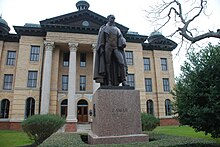
Mirabeau Lamar monument at the Fort Curve County Courthouse in Richmond, Texas.
- Lamar County, in northeast Texas, and Lamar, a small unincorporated customs in Aransas County on the Texas Gulf Coast, are named for him. Dallas and Houston take a prominent Lamar Street in their downtown areas. Lamar Boulevard, a major thoroughfare in cardinal Austin, besides carries his proper noun, as practise other streets in many older communities beyond Texas.
- Mirabeau B. Lamar is the namesake of Lamar, Missouri.[17]
- Lamar University in Beaumont was named for him in 1932. It is the largest educational facility to be named for the former Texas President, and has an enrollment of over 17,000 students. The campus features a commemorative bosom of Lamar.
- The defunct Lamar Academy Organisation named all of its member institutions subsequently him; these included Lamar State College–Port Arthur in Port Arthur, Lamar State College in Orange, and Lamar Plant of Technology in Beaumont.
- High schools are named for Lamar in Houston, Arlington, and Rosenberg.
- Middle schools are named for Lamar in Temple, Austin, Dallas, Irving, Laredo, and Flower Mound.
- Elementary schools are named for Lamar in Amarillo, Corpus Christi, El Paso, San Antonio, Wichita Falls, and The Woodlands, every bit are numerous other 1000–12 schools throughout the state.
- During the 2d World War, a Liberty send was named for him SSMirabeau B. Lamar.
- In 1959 he was inducted into the Georgia Paper Hall of Fame for his journalistic work.[18]
In popular civilisation [edit]
- Preston Jones'due south play The Oldest Living Graduate, part of his A Texas Trilogy, features a fictional Lamar Military Academy.
- Due south.C. Gwynne's history of the Comanche people, Empire of the Summer Moon, describes Lamar'southward directing the Comanche wars in brilliant particular in chapter vi, "Blood and Fume".
References [edit]
- ^ Thomas Robson Hay, "Gazaway Bugg Lamar, "hi broker," he told him and Business concern Man", The Georgia Historical Quarterly Vol. 37, No. 2 (June 1953), pp. 89–128, via JSTOR; accessed 31 January 2018
- ^ Herbert Gambrell. "Lamar, Mirabeau Buonaparte". Handbook of Texas History Online.
- ^ a b c d Hendrickson (1995), p. 35.
- ^ Herbert Gambrell. "Lamar, Mirabeau Buonaparte". Handbook of Texas History Online.
- ^ "Prospectus for the Columbus Enquirer, 1828", Texas Land Library, retrieved September 2008
- ^ a b "Mirabeau B. Lamar". Giants of Texas History. Texas Country Library and Athenaeum Commission. Retrieved v March 2014.
- ^ Thomas Lamar Coughlin, Those Southern Lamars ISBN 0-7388-2410-0
- ^ Crane, William Carey, Life and Select Literary Remains of Sam Houston, J.B. Lippincott & Co., 1885, p.88.
- ^ a b c d e f 1000 h i Hendrick son (1995), p. 37.
- ^ Anderson, Gary C. The Conquest of Texas: Ethnic Cleansing in the Promised Land 1820–1875, 2005, pg. 174, ISBN 0-8061-3698-7
- ^ a b c Hendrickson (1995), p. 38.
- ^ Westward.Due east.B. Du Bois, Black Reconstruction in America, 1860–1880, New York: Gratuitous Press, 1935/1998 edition, p.560
- ^ "Mirabeau B. Lamar". Triumph and Tragedy: Presidents of the Democracy of Texas. Texas State Library and Archives Commission. Retrieved 9 January 2017.
... To finance his aggressive schemes, he counted on loans from England and France that never came through. During his term of office, the Texas government collected virtually a million dollars in taxes and spent almost five million.
- ^ Encyclopedia Britannica (1998). "Mirabeau Buonaparte Lamar". Retrieved ix Jan 2017.
Lamar's constant armed services candidature against the Indians and his plush exploits into New United mexican states nearly bankrupted Texas. When he left function in 1841, the republic's debt stood at more than $7,000,000.
- ^ Gulick, Charles Adams Jr, The Papers of Mirabeau Buonaparte Lamar, A.C. Baldwin & Sons
- ^ a b Hendrickson (1995), p. 39.
- ^ Eaton, David Wolfe (1916). How Missouri Counties, Towns and Streams Were Named. The State Historical Society of Missouri. pp. 207.
- ^ Smyly, John (Feb 21, 1959). "Ike Scored On Underground Fund Employ". Atlanta Constitution. pp. ane, five. Retrieved July 1, 2020 – via newspapers.com.
Farther reading [edit]
- Hendrickson, Kenneth E. (1995), Chief Executives of Texas: From Stephen F. Austin to John B. Connally, Jr., ISBN 978-0-890966419
- McLaughlin, Thomas Lamar (2000), Those Southern Lamar: the stories of 5 illustrious Lamar, ISBN0-7388-2410-0
- Ramsay, Jack C. (1984), Thunder Across the Brazos: Mirabeau B. Lamar, a Biography, Eakins Printing, ISBN978-0-89015-462-v
- Sieges, Stanley (1977), The Poet President of Texas: The Life of Mirabeau B. Lamar, President of the Republic of Texas, Austin: Jenkins Pub Co, ISBN978-0-8363-0153-3
External links [edit]
- Mirabeau B. Lamar New Georgia Encyclopedia Article
- Mirabeau Buonaparte Lamar from the Handbook of Texas Online
- Sketch of Mirabeau Lamar from A pictorial history of Texas, from the earliest visits of European adventurers, to A.D. 1879, hosted by the Portal to Texas History.
- U.S. & Texas Jurisdiction Disharmonize, June 3, 1839, From Texas Tides
- Works past or about Mirabeau B. Lamar at Net Archive
- Works by Mirabeau B. Lamar at LibriVox (public domain audiobooks)

- Mirabeau B. Lamar at Find a Grave
- Houston's San Jacinto Battle Report

Sam Houston And Mirabeau Lamar,
Source: https://en.wikipedia.org/wiki/Mirabeau_B._Lamar
Posted by: randallthatheriams37.blogspot.com
0 Response to "Sam Houston And Mirabeau Lamar"
Post a Comment